
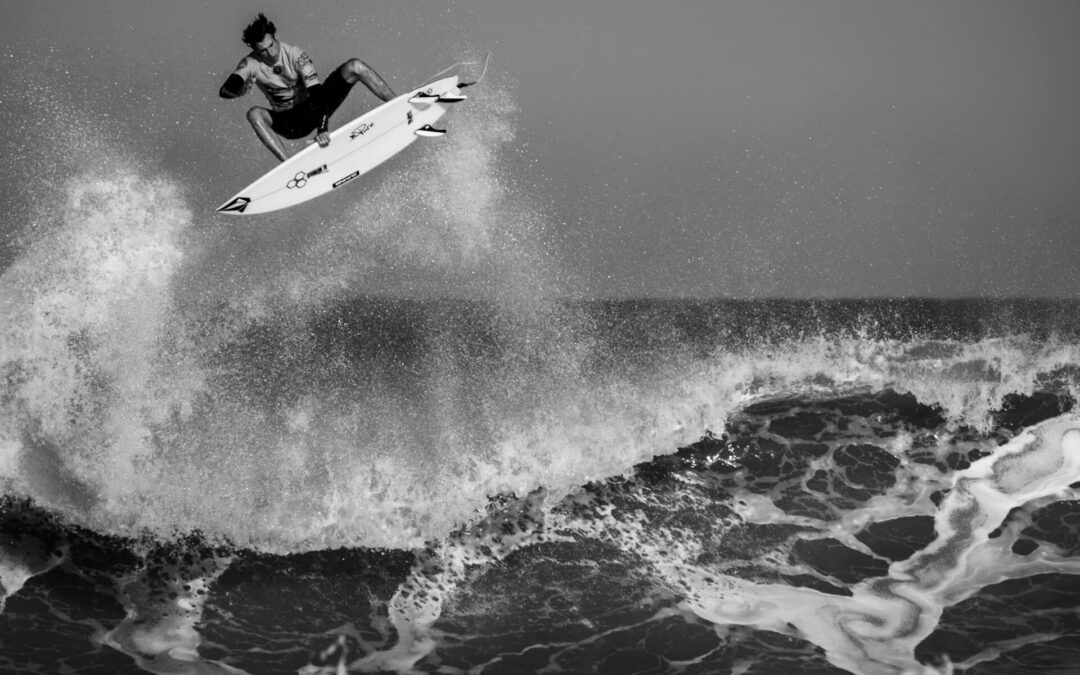
As aerial manoeuvres become increasingly important in competitive surfing, coaches are paying closer attention to the biomechanical strategies underpinning jump performance and landing resilience.
One observation commonly made during countermovement jump (CMJ) testing is that athletes often display different movement strategies despite achieving similar jump heights. Some athletes appear more knee-dominant, characterised by greater knee flexion and knee extensor contribution during propulsion, while others rely more heavily on hip flexion and extension, displaying a more hip-dominant strategy.
The question for surfing coaches is whether one strategy is preferable.
Understanding the Jump Strategy
The CMJ is fundamentally a whole-body movement requiring coordinated force production from the hip, knee, and ankle extensors. Higher-performing jumpers are not necessarily more knee-dominant or more hip-dominant; rather, they are generally more effective at producing and transmitting force through the entire kinetic chain.
However, movement strategies do differ.
Research investigating sex-based biomechanics has consistently shown that female athletes often demonstrate greater hip contribution and reduced knee extensor moments during various jumping, landing, and change-of-direction tasks. While this does not automatically reduce jump performance, it may indicate untapped capacity within the quadriceps and knee extensors that could contribute to greater force production and improved deceleration capabilities.
From a coaching perspective, this becomes particularly relevant when working with female surfers who require not only explosive propulsion for aerial manoeuvres but also the ability to tolerate repeated high-force landings.
Why Front Squats Are Often Used
Many surfing performance programs favour front squats over back squats when attempting to improve lower-limb power.
The rationale is less about front squats being a superior strength exercise and more about the movement qualities they encourage.
Compared with back squats, front squats typically result in:
- Greater knee extensor demand
- Increased quadriceps activation
- A more upright torso position
- Reduced forward trunk inclination
- Potentially greater transfer to positions commonly seen during take-off and landing mechanics
For athletes who naturally default to a hip-dominant strategy, front squats can provide a useful training stimulus that encourages greater contribution from the quadriceps without completely removing posterior chain involvement.
The objective is not to replace hip extension but to improve force-sharing across the lower limb.
Landing Resilience May Be More Important Than Jump Height
Interestingly, the greatest benefit of improved quadriceps function may not be increased jump height.
In surfing, the ability to absorb force is arguably just as important as the ability to generate it.
Aerial landings require substantial eccentric control from the quadriceps to manage knee flexion and dissipate ground reaction forces. Athletes who demonstrate poor knee extensor strength often compensate by shifting load elsewhere within the kinetic chain.
As a result, strengthening the quadriceps through front squats, split squats, and eccentric-focused training may contribute more to landing robustness than to maximal jump height itself.
What About Femoroacetabular Impingement?
Femoroacetabular impingement (FAI) is frequently observed in surfers due to the repetitive exposure to deep hip flexion, internal rotation, and rotational loading associated with paddling, pop-ups, bottom turns, and compressed surfing positions.
A common question is whether hip-dominant athletes are more susceptible.
At present, there is insufficient evidence to conclude that hip-dominant jumping or squatting directly causes FAI. The development of FAI appears multifactorial, involving osseous morphology, genetics, training exposure, movement volume, and individual anatomical characteristics.
Nevertheless, movement strategy likely influences where mechanical stress is distributed.
Athletes who consistently rely on the hips for force production may expose the hip joint and surrounding tissues to greater cumulative loading. Conversely, athletes who become excessively knee-dominant may shift stress toward the patellofemoral joint and other anterior knee structures.
Neither extreme is desirable.
The goal should be the development of a balanced athlete capable of generating force through both the hip and knee extensors while maintaining sufficient mobility and movement variability to distribute loads effectively.
Practical Takeaways for Coaches working with Surfers
Rather than asking whether knee-dominant or hip-dominant is best, coaches should identify whether an athlete is over-reliant on one strategy.
For female surfers in particular, improving quadriceps strength and knee extensor capacity through exercises such as front squats, split squats, and loaded jumping may help unlock additional performance potential while improving landing resilience.
However, the highest-performing surfers are unlikely to be purely knee-dominant or purely hip-dominant. They are athletes who possess strong quadriceps, powerful hips, efficient ankle stiffness, and the ability to seamlessly coordinate all three joints during both propulsion and landing.
Ultimately, the goal of training is not to change an athlete’s natural movement pattern entirely, but to expand their options. The more force a surfer can produce and absorb through multiple joints, the more resilient and explosive they are likely to become in the water.
To Increase Movement Options and Build Resilience
Start by expanding your joint range of motion, control and end-range strength.